A Beginner’s Guide to Social Media for Solopreneurs and Bloggers

A Beginner’s Guide to Social Media for Solopreneurs and Bloggers starts with choosing the right platforms for your niche, focusing on where your ideal readers already hang out instead of trying to be everywhere at once. For most new creators, that means building authority on one primary channel (often Pinterest, TikTok, Instagram, or LinkedIn) while using a second platform to repurpose content and drive traffic back to your blog.
To grow consistently, optimize your profile with clear branding and a strong link to your main offer or lead magnet, then share a mix of educational posts, behind‑the‑scenes content, and direct blog promos that solve specific problems for your audience.
As you get data on what performs best, refine your strategy around those formats and topics so social media becomes a predictable engine for email subscribers, affiliate clicks, and loyal readers rather than a constant guessing game.
My New Pinterest Strategy for Growing a Food Blog
I recently made a big shift in how I approach Pinterest for my Tiny Niche Blog. Before, I was repining older pins over and over again. But I started wondering whether that behavior looked repetitive or even spammy to Pinterest’s algorithm.
So I changed my strategy completely.
1. No More Recycling Old Pins
Even if a pin used to go viral, I no longer keep resharing it repeatedly. Instead, when I create a brand-new pin, I distribute it strategically. Each fresh pin gets shared to three to five highly relevant boards — and that’s it.
My focus now is intentional distribution instead of volume.
2. Elevating My Pin Design
Pinterest is visual. If your design does not stop the scroll, it does not matter how good your content is.
I upgraded to Canva Pro and honestly, I love it. I use it for so many things on my blog — pin designs, blog graphics, lead magnets, thumbnails, and even internal visuals. It makes branding feel cohesive and simple.
I also use:
- Adobe for more advanced, professional graphic design work
- Nano Banana to create realistic images for my posts
- The good old ChatGPT can also generate amazing images
Images and strong visual presentation are critical in the food niche. Pinterest users click based on aesthetics first. Your design has to communicate quality instantly.
3. Publishing Only High-Quality, SEO-Optimized Content
I no longer publish quick posts just to stay active. Every article is now:
- Minimum 1,500 words
- Fully SEO optimized
- Focused on trending or high-interest topics
- Structured for both Google and Pinterest visibility
For research, I use tools like Ubersuggest and Ahrefs (and explore many others) to identify keyword opportunities and search demand. I also check Pinterest Trends to see what users are actively searching for on the platform.
For scheduling and staying consistent, I rely on:
Consistency matters, but automation makes it sustainable.
The Bigger Strategy Behind It All
This approach is simple but intentional:
- Fewer pins, better design
- Fewer posts, higher quality
- More research, less guessing
- Better tools, better systems
Instead of chasing volume, I am building authority, consistency, and visual cohesion. Pinterest rewards freshness and quality, and that is exactly what I am focusing on now.
This feels more strategic. And honestly, much more sustainable long term.
Part 2: My Topic and Keyword Research System
Pinterest traffic is visual, but it is still search-driven. That means guessing is not a strategy. Research is.
Over time, I built a simple but powerful research system that combines SEO data with Pinterest behavior.
1. Topic Research Comes First
Before I write anything, I validate the topic.
I use SEMrush to research broader content ideas, identify growing search trends, and analyze what is already ranking in my niche. It helps me understand:
- What topics are gaining traction
- Which competitors are ranking
- Whether a topic has long-term potential
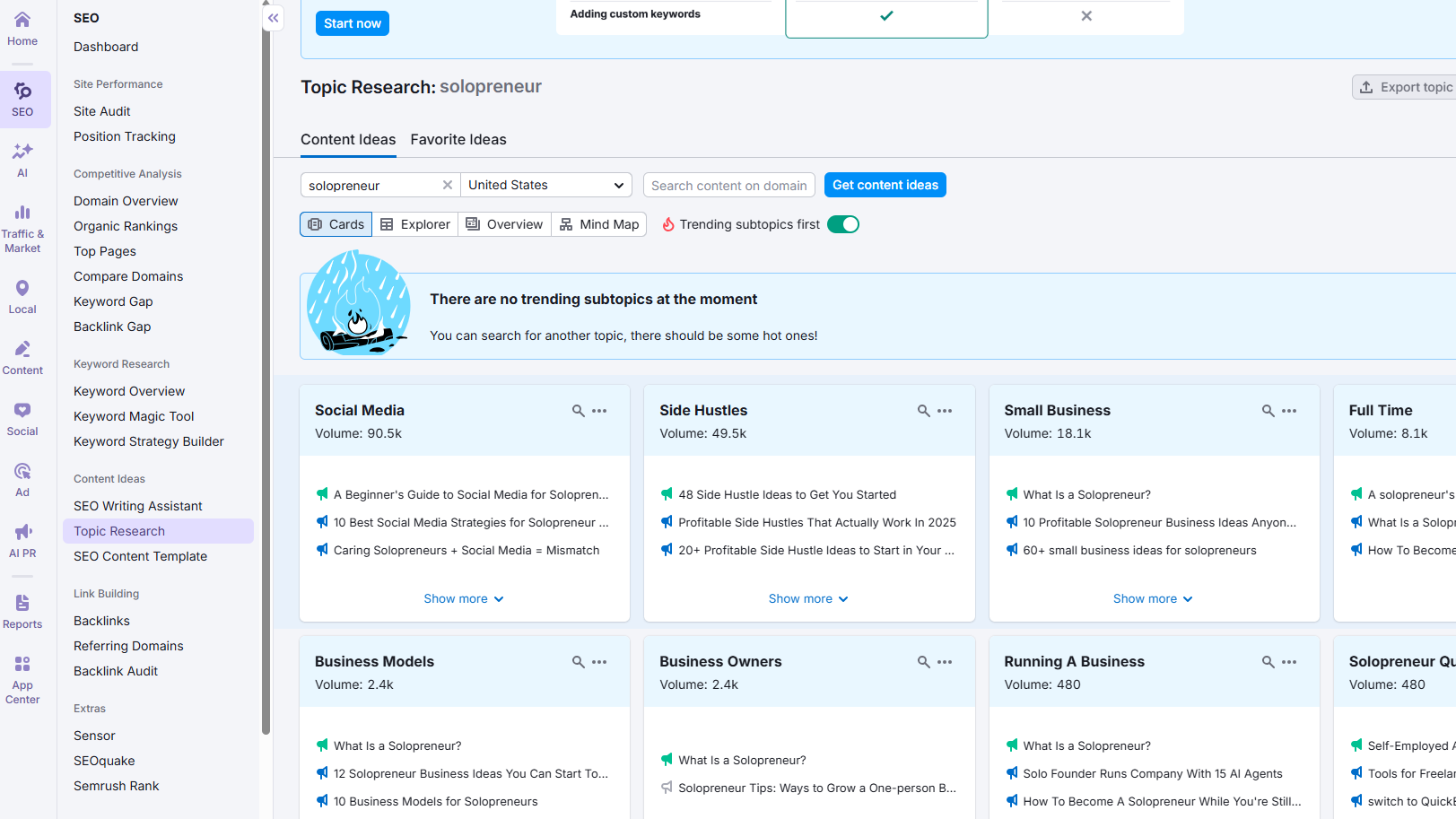
I just Love their Topic Research Tool. Its easy to use and helps me to craft relevant content ideas. I am not just looking for keywords. I am looking for demand.
If a topic shows consistent search volume and aligns with Pinterest trends, it moves to my content calendar.
2. Keyword Research Is Strategic
For deeper keyword analysis, my two favorite tools are:
I use them slightly differently.
With Ubersuggest, I like to quickly validate keyword ideas, check difficulty scores, and explore related keyword variations. It is very practical for spotting low-competition opportunities.
With Ahrefs, I go deeper. I analyze keyword difficulty, traffic potential, parent topics, and what pages are already ranking. I study the structure of top-performing content and identify gaps I can improve on.
I do not target random keywords. I target:
- Long-tail keywords
- Clear search intent
- Topics that align with Pinterest visuals
- Keywords that can support a 1,500+ word article
3. Pinterest Trends as a Validation Layer
After SEO validation, I cross-check everything with Pinterest Trends.
If Pinterest shows rising interest around a keyword or seasonal spike, that is confirmation for me. When Google demand and Pinterest demand align, that is where real momentum happens.
My Overall Research Formula
My process looks like this:
- Validate topic idea with SEMrush
- Analyze keyword difficulty
- Confirm trend direction on Pinterest Trends
- Build a high-quality, SEO-optimized article
- Design strong Pinterest visuals around that keyword
This system removes emotion from content creation. It replaces it with data.
And in a competitive niche like food, that clarity makes all the difference.
Part 3: Social Media Distribution and the Power of TikTok as a Search Engine
SEO and Pinterest are powerful, but they are not enough on their own anymore.
If you want stable, diversified traffic, you need to think platform-wide. Every platform today has its own internal search engine. And one of the most powerful right now — especially for Gen Z — is TikTok.
1. TikTok Is a Search Engine Now
Many Gen Z users do not go to Google first. They go to TikTok.
They search:
- “Easy dinner ideas”
- “High protein breakfast”
- “Quick meal prep for busy moms”
- “Budget grocery haul”
TikTok surfaces content based on keywords in captions, on-screen text, voice, and engagement signals. That means your short-form video can rank inside TikTok search the same way your blog ranks in Google.
If you are in the food niche, this is huge.
Short, vertical videos showing:
- Step-by-step recipes
- Ingredient swaps
- Before and after visuals
- Quick cooking hacks
can drive both platform engagement and blog traffic.
TikTok is not just for dancing trends anymore. It is a discovery engine.
Platforms like Instagram, YouTube, and even Facebook still matter. They have strong user bases and solid algorithmic reach. But exploring newer or trending platforms keeps your brand future-proof.
You do not want to depend on a single traffic source.
2. Showing Up Consistently Everywhere
The real strategy is visibility.
You want your audience to see you everywhere:
- In Google search
- On Pinterest
- On TikTok
- On Instagram
- On YouTube
Each platform reinforces your authority.
When someone sees your recipe on Pinterest, then sees your TikTok video explaining it, then finds your full article on Google, trust builds naturally.
And trust converts.
4. Engagement Is the Real Growth Lever
Traffic is important, but engagement is what builds a brand.
Reply to comments.
Ask questions.
Create fresh variations of trending topics.
Show personality.
Especially with Gen Z audiences, authenticity wins. Overly polished content can feel distant. Short, real, helpful videos perform better than perfect ones.
The Bigger Goal
The goal is simple:
Show up on every relevant platform.
Stay consistent.
Publish fresh, interesting content regularly.
Pinterest brings search-based discovery.
Google brings long-term SEO traffic.
TikTok brings viral search and younger audiences.
Together, they create a steady, diversified traffic ecosystem.
And in today’s blogging world, diversification is not optional. It is strategic.