Decagon Case Study: How Jesse Zhang Built $35M ARR AI Support in 18 Months
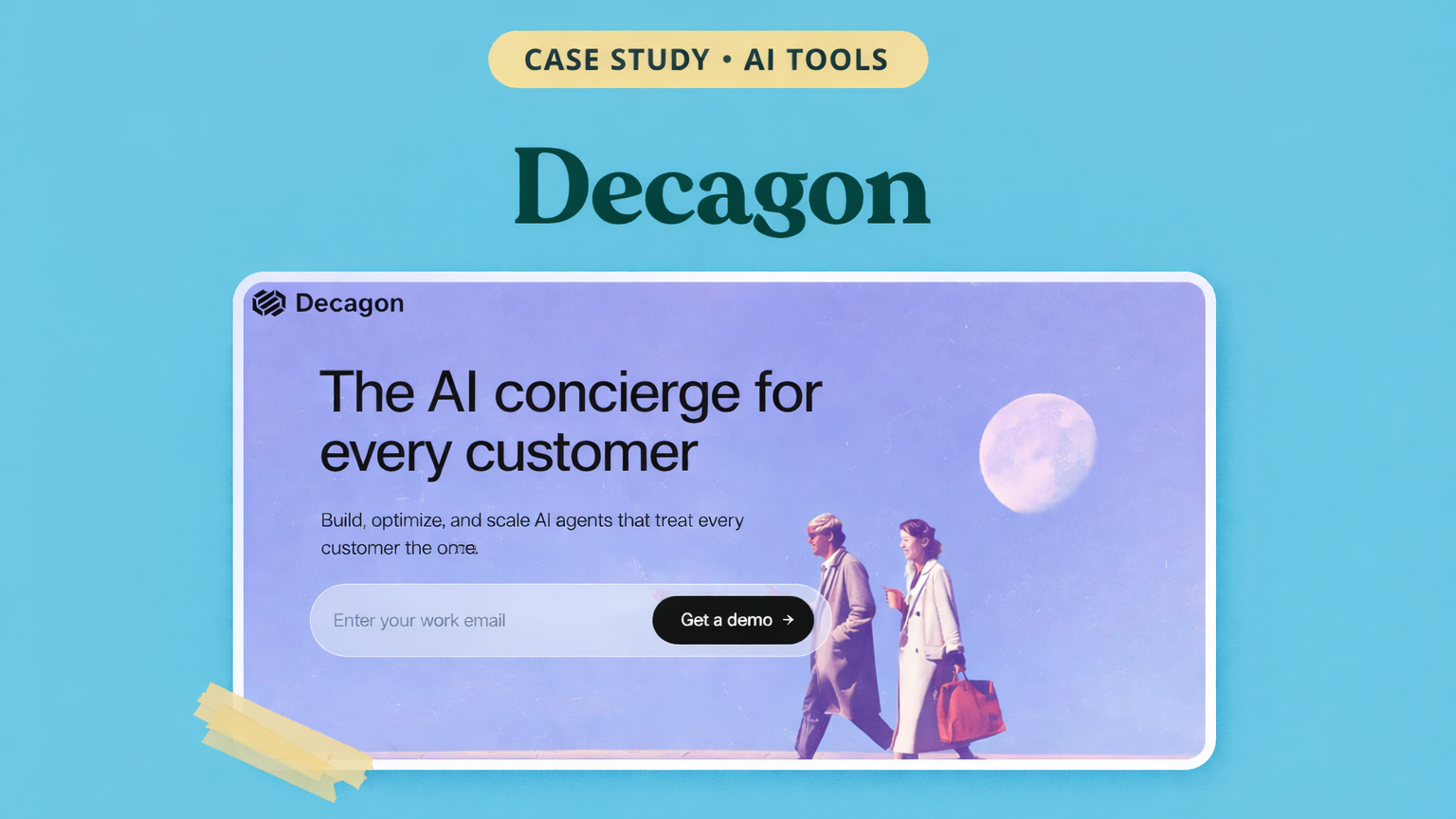
Decagon case study examines how two technical founders turned aggressive customer discovery into a $4.5 billion AI customer support company serving 100+ enterprise clients in under two years.
What Decagon Is
Decagon builds AI agents that handle end-to-end customer service tasks across chat, email, and voice channels, including processing refunds, canceling subscriptions, tracking orders, and booking travel.
The Founder Story
Jesse Zhang is a 28-year-old serial entrepreneur who previously founded Lowkey, a consumer social app acquired by Niantic in 2022. He met co-founder Ashwin Sreenivas at an Andreessen Horowitz retreat in Utah where both were deciding what to build next after selling their previous companies.
Zhang grew up in Boulder, studied computer science at Harvard, and worked briefly at Citadel. His first startup taught him consumer apps weren’t his strength. With Decagon, he deliberately chose B2B enterprise software where customer conversations drive product direction.
The Problem Decagon Solves
Traditional customer support platforms like Zendesk and Salesforce Service Cloud force businesses into rigid workflows that can’t personalize at scale. Human support teams are expensive, limited by time zones, and struggle with consistency across languages and channels. Generic AI chatbots can’t access company systems to take actions, they only answer questions.
Decagon targets mid-market to enterprise companies with high support volumes who want AI agents that actually resolve issues end-to-end, not just provide information. Use cases span travel, fintech, healthcare, retail, and SaaS.
Product Snapshot
Based on the Decagon site, core platform includes:
- Agent Operating Procedures using natural language to define workflows
- Omnichannel deployment across voice, chat, email, SMS
- Unified knowledge graph accessing real-time company data
- Integration with existing business systems and workflows
- Robust testing, observability, and experimentation tools
- Analytics suite tracking conversation insights and performance
- Voice AI built with ElevenLabs partnership launched February 2025
Agents can answer questions, process refunds, cancel subscriptions, dispute transactions, replace credit cards, track orders, and book travel by accessing internal systems directly.
Technical infrastructure built on Prisma Postgres per competitive analysis mentions.
Pricing: Custom enterprise contracts with two models: per-conversation or per-resolution. Annual contracts reportedly range $95,000 to $590,000+ depending on volume per competitor analysis.
Growth Signals
Forbes and Sacra documented the trajectory:
- Founded 2023 after GPT-4 launch during peak AI hype
- Hit $10M ARR by end of 2024
- Reached $35M ARR by October 2025 per Sacra estimates
- Added 100+ enterprise customers in 2025 including Avis Budget Group, Deutsche Telekom, Mercado Libre, Bilt, Notion, Webflow, Duolingo, Substack, and Chime
- Raised $255M total funding: $650M valuation June 2025, then $4.5B valuation January 2026
- Funding led by Coatue, Index Ventures, Andreessen Horowitz, Accel, Bain Capital Ventures
- Team scaled to 200 employees
- One client reduced support team from hundreds to 65 staff, saving hundreds of thousands monthly per Sacra
Reported customer results: 90% resolution rate without human intervention for some clients, 70-80% deflection rates, 3x increase in CSAT scores.
Monetization Model
Decagon operates on enterprise SaaS contracts with usage-based pricing. Two models offered per Decagon blog:
Per-conversation: Fixed rate for every incoming conversation with volume discounts. This is the more popular model, chosen by majority of customers for transparency and predictability.
Per-resolution: Higher fixed rate charged only when AI fully resolves issue without human escalation. No charge for escalations. Larger resolution commitments lower the per-resolution rate.
Contracts are custom quoted, not publicly listed. Reported range $95,000 to $590,000+ annually based on conversation volume. Revenue likely driven by monthly subscriptions billed annually with potential overage charges.
What’s Smart About the Strategy
Timing the AI wave perfectly. Founded immediately after GPT-4 launch in early 2023 when enterprises were scrambling for AI use cases. Customer service was the clearest enterprise AI application. Zhang didn’t create demand, he caught the wave.
Aggressive customer discovery before building. Jesse and Ashwin spent weeks talking to potential customers asking exactly how much they’d pay for solutions. They didn’t build until they found a problem people would write checks for immediately. This validated product-market fit pre-product.
Vertical focus wins horizontal markets. They didn’t build “general AI agents.” They built customer service agents exclusively. This focus created deeper product capabilities and clearer positioning versus horizontal agent platforms that do everything poorly.
Enterprise-only from day one. No freemium, no small business tier. Custom enterprise contracts with six-figure minimums filter for serious buyers and create revenue concentration. One enterprise client equals 50 SMB customers.
Natural language workflows, not code. Agent Operating Procedures use plain English to define agent behavior. Non-technical CX teams can modify workflows without engineering sprints or vendor support tickets. This removes biggest enterprise adoption friction.
Revenue multiple growth, not just customer count. Ivan Zhou from Accel bet his hair they’d 10x revenue, which they did. Zhang focuses on expansion revenue within existing accounts, not just new logos.
Risks and Limitations
Intense competition with massive incumbents. Salesforce, Zendesk, and Intercom all building AI agents. Well-funded startups like Sierra also competing. Forbes notes Zhang is “unfazed” but incumbents have distribution advantages.
LLM provider dependence. Product relies on third-party language models. If OpenAI, Anthropic, or others change pricing or capabilities, margins and product quality suffer immediately.
Pricing opacity creates friction. Custom quotes with six-figure minimums exclude mid-market entirely. Competitors offer transparent tiered pricing starting at $39/month, creating accessibility advantage.
Implementation complexity. Deployment reportedly requires weeks to months with “Agent Engineers” per pagergpt analysis, creating onboarding barrier versus plug-and-play alternatives.
Valuation pressure. $4.5B valuation after 18 months creates enormous exit expectations. Company must scale past $100M ARR to justify current pricing or risk down rounds.
Takeaways for Bloggers and Solopreneurs
Ask customers what they’ll pay before you build. Jesse’s discovery process involved directly asking prospects how much they’d pay for specific solutions. If they hesitate or deflect, the problem isn’t urgent enough.
Build during hype cycles, but focus on real problems. AI agent hype created curiosity. Customer service pain created revenue. Hype gets meetings, pain gets contracts.
Vertical depth beats horizontal breadth. Decagon didn’t build “AI for everything.” They built customer service agents exclusively. Narrow focus created 90% resolution rates competitors can’t match.
Enterprise requires different muscle than consumer. Jesse’s first company was consumer, which he admits wasn’t his strength. B2B requires patience with longer sales cycles but delivers concentrated revenue and predictable growth.
Show immediate ROI on metrics customers already track. Decagon reports 65% cost reduction, 80% deflection rates, 3x CSAT increases. These metrics map directly to executive dashboards. Your product must move numbers leadership already measures.
Many high-growth startups begin with lean teams and strong execution principles similar to those used when building a modern one-person business.